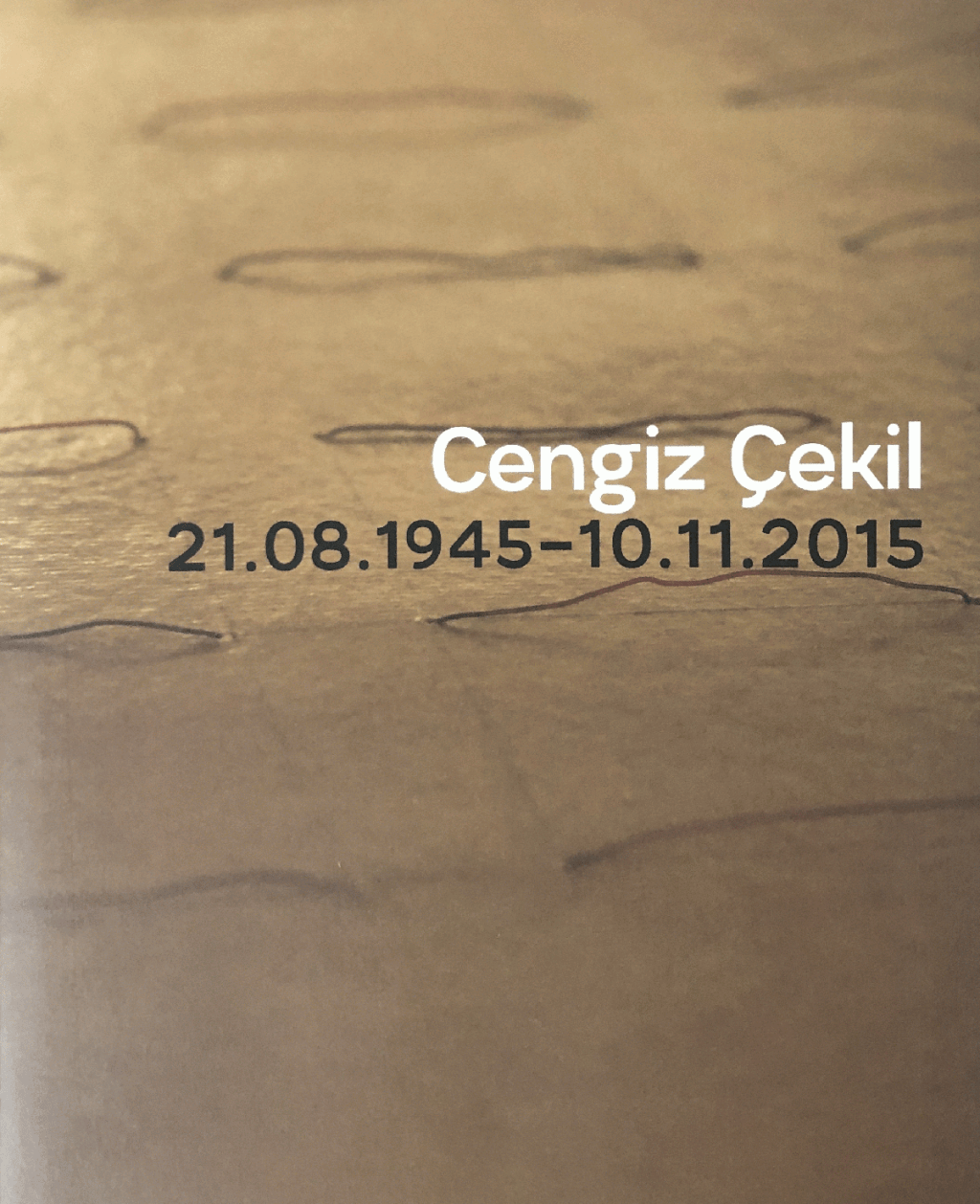
“Gazi Education Institute and Cengiz Çekil”, Cengiz Çekil: 21.08.1945 – 10.11.2015, SALT : Istanbul, 2020
The Gazi Institute of Education (Primary and Secondary Teachers’ College) was established in 1926 and, true to its name, was an institution of the Republic; it was Ankara. It did not remotely resemble the Istanbul institution that saw gradual changes from the Sanayi-i Nefise (School of Fine Arts) to the Academy of Fine Arts. Even though Turks replaced the professors after the Young Turk Revolution in 1909, it had not structurally transformed into a new model. Still, it received an ideological makeover from the late Ottoman to the early Republic. At Gazi, however, the modeling of the curricula had not followed the course of a cosmopolitan and Francophone modernism. Simultaneously with German-influenced models, Gazi facilitated the education of a significant number of youths in the impoverished Ankara, adhering to an ideological framework that addressed the pressing needs of the early Republic. Gazi teachers, in turn, edified rural areas. It is impossible to describe this institution, which is a product of the Early Republic’s vision and the Academy, simply through their differences. If we add the 1957-founded School of Applied Fine Arts to this list and trace each school through its graduates, we can see how different these institutions’ educational practices are and how influential they have been in Turkish art until recently. It would also be too generic to define these schools as versions of Beaux-Arts, Deutscher Werkbund, or Bauhaus since they have become regionalized over time with their subjects and typologies.
The epic efforts of the founding generation shaped Gazi. It did not only include a distilled modernism as a mission. Still, it was also associated with German progressivism and followed a more Soviet-based “decentralized, grassroots development” strategy in the 1930s. During its foundational period, individuals such as Ismail Hakkı Baltacıoğlu did not just imitate or pursue schooling practices established elsewhere; they were pioneers. They provided an education as comprehensive as the missionary schools operational in Anatolia in the 19th century. The Fine Arts Teaching Department, which would train art teachers, was established in 1932. The initial curriculum was not geared toward specialization. The head of the department was İsmail Hakkı Tonguç. Tonguç was the General Director of Primary Education, in addition to being one of the founders of the village institutes. Gazi’s colossal building was designed by the architect Mr. Kemaleddin, who died just before its completion. Families of modest means sent their children to Gazi; most students were boarders. They were not middle-class urbanites but rather bright rural youth entrusted to the government to be educated to fulfill a mission. In an interview with one of the students, Vahap Avşar, Cengiz Çekil states that the school was “a perfect environment for poor students: a homey place where copies of great Western masterpieces hung in the hallways and good food was served from the kitchen.” The faculty of Gazi included Zühtü Müridoğlu, art historian and painter Malik Aksel, and later figures like Turan Erol, Adnan Turani, and Kayıhan Keskinok, who all played an important role in Turkey’s intellectual life. At the beginning of the 1960s, separate departments such as graphics and painting were established. They offered a relative opportunity for greater specialization.
Cengiz Çekil studied graphics, modeling, and sculpture at Gazi; he worked on book covers, posters, and logo designs; he learned engraving techniques such as silk-screening, woodblock, and linocuts, as well as carpentry in woodworking classes, and binding, marbling, and Papier-mâché in the paper and cardboard workshops. The “basic art education,” launched at the Academy around the same time in the late 1960s, had been just as transformative. Still, the specialization at Gazi was relatively up to the students. The students had been through a program where they were acclimated to many different materials rather than being attached to traditionally endorsed media such as painting, engraving, or sculpture. Gazi graduates like Osman Dinç, Cengiz Çekil and İsmail Saray did not assume “an artistic identity” or engage in a particular style or medium-based practice. Hence, compared to their Academy of Fine Arts counterparts, they had a much easier time adapting to the advanced visual practices in the West European cities when they were on scholarship from the state for further education.
The Fine Arts Teaching Department at Gazi was appreciably more modest than the Academy. Malik Aksel was one of the first instructors of this school, educating teachers to be skilled in the use of different media and to acquire a fundamental perspective of art history. Malik Aksel is the author of essential books on the vibrant visual folklore of Anatolia. Aksel is one of the figures who could respond to a question that Çekil posed in an interview: “We look for references. Where do we start? Do we start with the Hittites or Ancient Greece? Where do we get our influences? From miniatures?” Just like İsmail Saray, a year older than him, Çekil was deeply influenced by Malik Aksel’s writings. Saray’s father was a signboard and carriage body painter. Çekil’s father was a repairman who could fix anything from clocks to engines; this, combined with the local knowledge, experience, and muscle memory that stemmed from the artists’ immediate surroundings, informed the practices they would develop in the future.
Çekil’s Gazi period, between 1965 and 1968, was critical for Turkey. The Algerian War of Independence and the shaping of the struggles for independence against colonialism occurred in the 1960s, profoundly influencing European intellectuals. It was also the time when the Non-Alignment Movement was at its strongest. With regards to Turkey, it was a renaissance in which the founding generation yielded their place to younger actors while conservative thought was unable to regenerate itself following the deaths of writers like Refik Halit Karay, Ahmed Hamdi Tanpınar and Peyami Safa; one when freedoms were expanded with the constitution of 1960; the Turkish Workers’ Party (TİP) was founded; Sencer Divitçioğlu launched the debate on the Asiatic Mode of Production, books banned previously were being published and translations of contemporary literature and thought were made; and several progressive magazines appeared.
Ankara in the 1960s was a place of intense student upheaval. Socialist literature played a critical role in this dynamic city as well. Cengiz Çekil says in an interview, “Theaters had an essential place in our social life. There were many important theaters, such as Devlet Tiyatroları (The State Theaters), Ankara Sanat Tiyatrosu (The Ankara Art Theater), and Halk Oyuncuları (Peoples’ Theater). There was Vasıf Öngören; I had seen his adaptations of Brecht, the play Asiye Nasıl Kurtulur? (How to Save Asiye?) during that time. It was a period when we discussed Brechtian theater a lot and had many intense discussions about art.” Even though Çekil started forming references for his practice during his time in France, the Ankara atmosphere of the era is significant. He mentions the national/universal cinema debates of the famous directors Halit Refiğ, Ömer Lütfi Akad, and Metin Erksan, and the arguments picked up in magazines like Yeni Dergi, Papirüs, and Adnan Turani’s Art and Artists. Among the things he remembers about Ankara are the world-touring art exhibitions at the French Cultural Center, the American Cultural Center, and the German Cultural Center. Çekil recounts, “It was a large exhibition, and that’s where we saw Henry Moore. I remember the exhibitions at the American Cultural Center, and İhsan Cemal Karaburçak’s exhibition at the United States Information Service near Kızılay. I remember rushing to Metin Erksan’s gala at the French Cultural Center. I ran into Metin Erksan when I stepped out of the cinema; we’d sat and talked about the film… One of the most important events in Ankara was the State Art and Sculpture Exhibitions. I had works shown at these exhibitions during my second and third years at the Gazi Institute. In fact, the work I exhibited in my third year was bought by the state. An article had appeared in a newspaper at the time, in 1968, titled “Promising Young Artists.”
In 1970, Çekil went to Paris on a state scholarship to study for a second bachelor’s degree at the École Nationale Supérieure des Beaux-Arts. In Paris, he became interested in a pared-down, tactile conceptualism with a distinct local accent. Cengiz Çekil, like İsmail Saray, Osman Dinç, and Mustafa Altıntaş, evolves into a different practice. His Academy contemporaries, like Füsun Onur, who studied in the US, retained their styles before and after France. The practices of women artists such as Onur, Gülsün Karamustafa, Ayşe Erkmen, or Gazi graduates and a range of other artists may not resemble one another, but how they have transformed bears similarities. They have legitimate grievances against Istanbul’s sexist Academy, which, despite internal conflicts, establishes the canon and renders aesthetic judgments. Some of these artists’ local disengagement and ability to adapt to changing circumstances would bring them together in the second half of the 1980s. The reason that Çekil withdraws to İzmir after his return from Paris is not only due to political unrest and his concern for getting arrested but because he cannot find a point of anchor in Istanbul even though he is producing crucial work that defines his time. Istanbul is not hospitable to Çekil. He has no circle of refuge.
In Paris, Çekil develops a lasting bond with his professor, Étienne Martin, and is influenced mainly by Joseph Beuys, Duchamp, and Sarkis. Çekil becomes unique among his contemporaries upon his return to Istanbul with his ability to make do with what’s at hand. His work, printed on mimeograph paper mimicking political pamphlets with manifestos, and his use of familiar and ubiquitous materials like the inexpensive medium of newspapers, take up no space, are easy to conceal, and run parallel to real life. One of the most striking of his works at the time is Günce / Diary (1976), an expression of surrender and resistance to terror. He stamps the words “I’m still alive today” on a page every day and dates the entry. Then, he mutes the front page of a newspaper by striking out all the writing. Manifestos, which are printed on mimeograph paper like political communiques reproduced in limited numbers and distributed on the streets, make no statements but repeat commonplace sentences such as “Life ends but the road goes on” as if gracefully resigning to fatalism.
Malik Aksel had an impact on works like Ayin İçin Bir Levha (Banner for a Ritual) and Yaşanmış Bir Yılın Takvimi (Calendar of a Year Lived), which were made around the same time and with the same level of care. They are responses to his explorations for a point of reference dating back to his student years at Gazi, and they run parallel to a distinct visual culture in Anatolia. Çekil is unequaled in transferring (translating)—while maintaining a distance—what he inherited from folklore and muscle memory to his work. When we look at different disciplines simultaneously, we can compare the notions of the local between an architect such as Cengiz Bektaş and Cengiz Çekil without them being similar in a formal delivery. Çekil, in his off-center conceptual practices, develops a resourceful, prudent, and un-wasteful approach. He utilizes limited materials, yet does so without taking a heavy stance against consumer and waste culture. His relationship to materials does not imply a rhetoric against wealth and consumption but is based on a culturally inscribed thriftiness and on the necessities imposed by living conditions. Not resorting to classic art materials such as canvas, cloth, or stone brings Çekil closer to conceptual art practices, but his relationship with material remains much more intense and intentional.
After returning from Paris, Çekil fulfills his mandatory service in return for his state scholarship as a desk clerk in Istanbul and defects to the sleepy Aegean city of İzmir in 1978. There, he finished his master’s degree and started teaching at the Faculty of Fine Arts at Ege University.
In İzmir, which is at the art world’s periphery, Çekil uses the streets as his studio. He records his daily route with black-and-white photos in his work, Görsel Parkurlar / Visual Tracks; he utilizes ordinary and low-density objects that he finds in small manufacturing workshops and from thrift stores or junk dealers; he continues to work with non-exclusive materials. Çekil possesses a deep respect for artisanship, a modest aesthetic sensibility, and a transparent relationship with materials.
Çekil is in İzmir during the coup of 1980. In his series, such as Maşallah / May God Save You and Evet / Yes, we can see a fine-tuned conflict with the system of September 12. Between 1983 and 1987, he creates Ataturk busts, which are in high demand. His students Vahap Avşar and Oktay Şahinler subtly mock Çekil and his busts with their works: Avşar with his paintings of coarse Atatürk busts and Şahinler with busts where he depicts himself.
Having devoted his life to his students in İzmir, Çekil eventually becomes the legendary teacher of the school. His deep, stentorian voice and his passionate tirades become his trademark. The department he established with his students is still awaiting appraisal in Turkish art history.
In the 1980s, Çekil participated in the A Cross Section of Avant-garde Turkish Art exhibitions and the subsequent series of projects. In these exhibitions, he fabricated İsmail Saray’s works with Saray’s instructions, as Saray is unable to return to Turkey at the time. In 1986, he organized projects such as the exhibition An Another Art: For the Memory of Joseph Beuys. He created interventions based on regional folklore during this period. He capitalized on the names given to various objects for sale, which he placed on large, light-colored sheets on the ground. From souvenirs to watermelons, the sheets serve as a frame known locally as an “exhibition.” For Çekil, such a presentation on the ground is a humble attitude, submitting to gravity and dismissing the hierarchical order of exhibition spaces. He used this trope for his three-dimensional works throughout the 1980s. The cloth also sometimes resembles shrouds and is multilayered in evocating certain cultural ceremonies.
Çekil’s practice establishes a corridor of dissent in the canons of art history. His last work was an installation that also refers to domestic violence, consisting of yellow cleaning cloths folded to resemble a woman’s sexual organ and bordered with lace swatches of lively colors, mounted on 144 simple canvas frames. Çekil, mischievous and at the same time in an apologetic manner, says that the piece is his first feminist work. Unsurprisingly, the consummately gentle Çekil chose to spend his last days in İzmir, the mild city that took excellent care of him.
 vasıf kortun