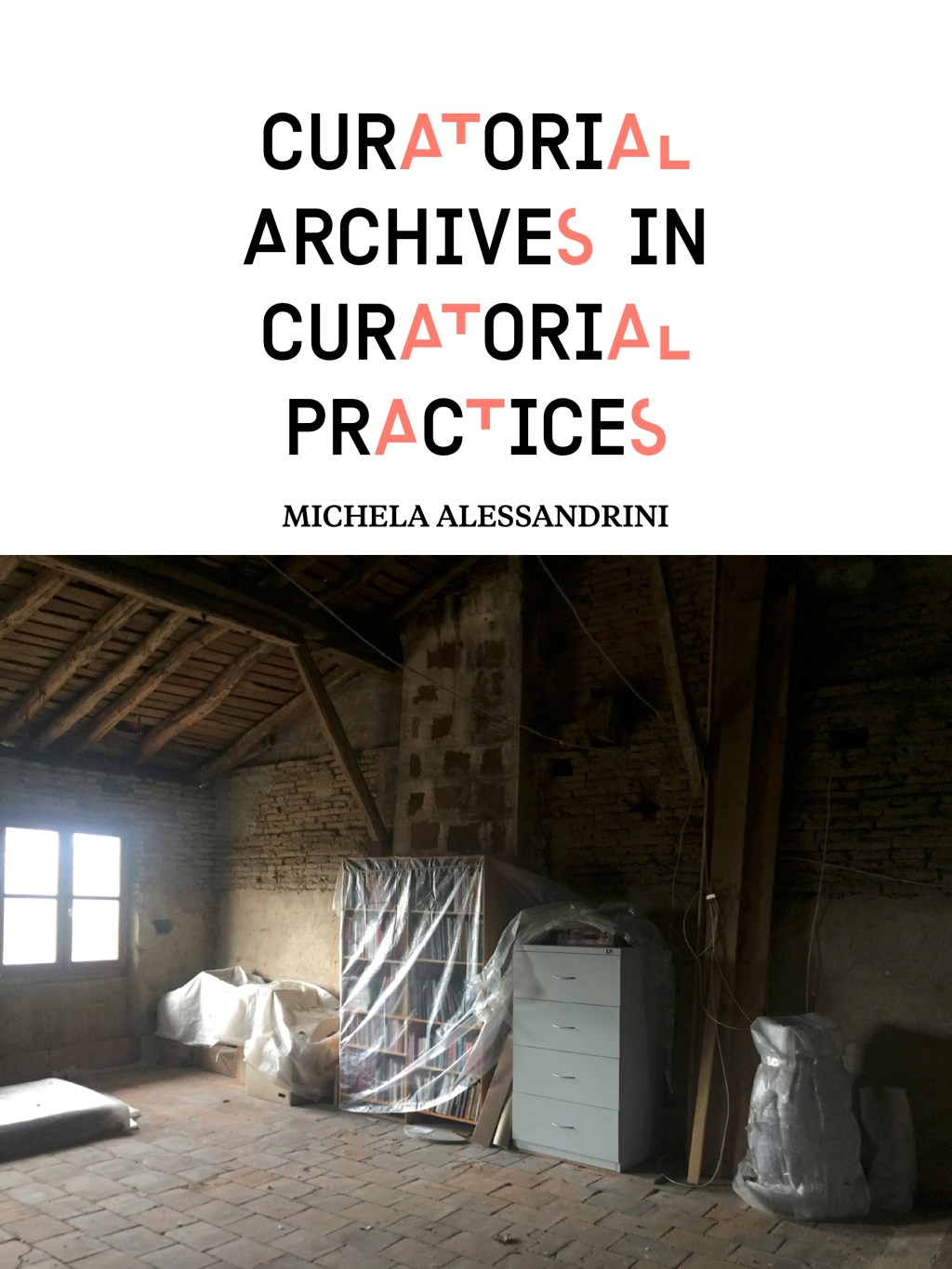
“The Orphan Archive”, Curatorial Archives in Curatorial Practices, Istanbul : SALT, 2018
A conversation with Michela Alessandrini
The first time we met, we talked about SALT archives, remember? Now, let’s talk about your own archive.
Oh God. Do you mean my own personal archive?
Well, this reaction is already an answer! It seems that every curator has a different approach to it…
Sure, it is true. I kept certain things early on and quite diligently, but archiving oneself is a perverse activity. One cannot be both the object and the subject of their interest. The focus of curating is not the curator but the individualization of the practice, which includes the curator but is not limited to them.
As I said, I have kept things that should be kept, and they are a very solid base of materials. This was up to the ’90s’, and then I became increasingly negligent. One does not keep a copy of each letter sent out. Nowadays, everything is digitally automatically archived, but the everyday messages are not necessarily pertinent. The “archivable” changed in the mid-1990s when we moved from dial-up to broadband. Before, you had to complete everything in one go, more or less: everything had to be more strategized, careful and almost conclusive. Looking at the old messages, I realize how easier it was to put up an exhibition with one message because the substance is compressed intelligently. Nowadays, it’s “yes”, “no”, “perhaps”, measurements, a hundred photographs of the same space, etc. We waste a lot of time on noise. Filtering is really critical, and it goes in many directions; there is always an ideological form of filtering, and this action is not merely technical.
This is a point. Then, why the archive? What is the sense of the post-history one has in mind?
We recently staged an exhibition at SALT about three exhibitions, one of which I had organized back in 1993 and was a landmark for exhibition practice in Turkey.I had kept the documents very carefully because I knew this project was going to become history. But there is always a hierarchy among what’s kept: there are things you do not want to be seen, like missteps, perhaps to avoid being judged. Everything is online now. I gave it to the institution, and they took care of it, both physically and digitally.
So you do not have an archive in your private space.
I do not. I do not even have books. I am not attached to any object. I do not own anything. Everything goes to SALT.
Is it because of a practical reason, like conservation issues, or because you identify with the institution?
It concerns the scarcity of local resources we had years ago. Individual collections assume a public mission. Before the 1990s, not much literature on art existed. That’s when I started collecting beyond an individual need, almost like an institution. All the materials I donated to the institution were not even quirky or idiosyncratic. They came from me, but they were not even specific to me.
Tell me about SALT publication of VOTI The Union of the Imaginary’s archive then. Was it your initiative?
Not only. VOTI’s archive was never intended to be published. We were supposed to remain a close group in order to enable more sincerity. At the end of the 90s, when I was back in Istanbul, it was one of the few things that kept me awake. We were all around the world. It was part of a daily ritual: you go to the bakery in the morning, then return, turn on the computer and check who has written on the Forum. It was our way of keeping in touch with the world. We all felt strongly about being part of this world. None of us had an institutional position or a full-time job. We wanted to change the exhibition practices globally as well as the institutions. So, I always thought of keeping this memory intact somehow and making a book out of it. I tried to keep as much as possible during that time, printed out some of the materials, and scanned or saved the others, but I was still missing a lot.
Of course, we collaborated with VOTI’s archivist, Susan Hapgood, who entrusted more materials for the project. But she did not have all the documentation either. Carolyn Christov Bakargiev was one of the first VOTI people I met in Venice. We discussed the idea of publishing as a Documenta publication, but the time frame would not allow it. The critical aspect was Robert Fleck’s archive – he had printed everything and kept it in his summerhouse somewhere in France. It took us two years to get it from him. Then we went back to digital from printed and reconstructed the whole thread. That is how it came to be. This publication was the resurrection of this naïve and clean time of curating. We thought it essential to return to that memory and reconstruct some of VOTI’s major discussions.
 vasıf kortun