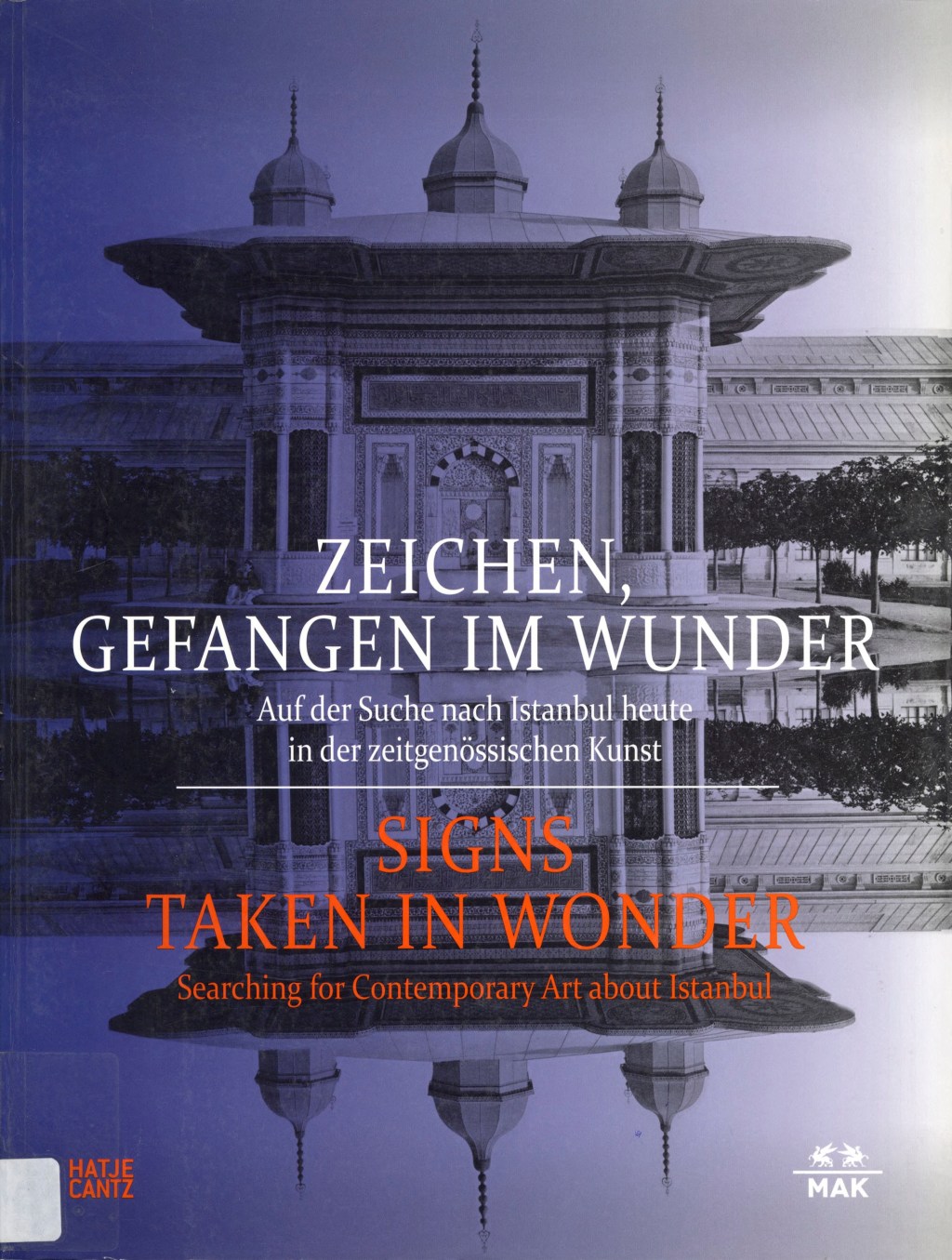
Interview (with Simon Rees and Bärbel Vischer): “Tall Tales and True: Talking about Turkish Contemporary Art”, Signs Taken in Wonder: Searching for Contemporary Art about Istanbul, Vienna : Hatje Cantz, 2013, pp. 69-73.
Curators of SIGNS TAKEN IN WONDER, Simon Rees and Bärbel Vischer, were constant visitors to the research library at SALT Galata (the most important research archive in Turkey) and the galleries at SALT Beyoglu on their research trips to Istanbul preceding the exhibition, where they were graciously hosted by the SALT’s Director of Programs and Research Vasif Kortun and his team. Some of their pointers lead to discoveries for the exhibition. Kortun, one of the foremost curators of major exhibitions internationally (with several biennials to his name), took time out from his busy schedule to speak to Rees and Vischer about the changing shape of the Turkish contemporary art scene.
Simon Rees and Bärbel Vischer [MAK]: You shifted back to Turkey from the United States and the museum at the Center for Curatorial Studies in 1997/98 in a moment synonymous with the biennale boom and the cool hunting of art from the peripheries by curators of those biennales: that had a transformational and globalizing effect on art everywhere including in Turkey. What would you typify as the major shifts that have occurred, within Istanbul, in relation to contemporary art, since 1998?
Vasif Kortun [VK]: The Istanbul of 1998 was the one-event town of the Biennial. I came back after Rosa Martinez’ memorable 1997 edition and except for the modest Borusan Art Gallery advised by Beral Madra, all was local, not bad, but suffocating. A terrific and restless group of artists all in their twenties, emerged in this context of low demand. None were from the Academy of Fine Arts. By the beginning of 2000 a few “Turkish” exhibitions took place in Western Europe. A channel had opened with like-minded artists and curators abroad, and residencies began to flourish. It was Turkey’s “YBA-moment,” post-dictatorship, post-1989, post-welfare, and neo-liberal to the core. The devastating economic crisis of 2001-2003 was helpful in that funding began to shift toward levelheaded institutional models. The EU- accession talks opened in late-2003 and the post-9-11 atmosphere allowed more access to support from abroad. Once the influential families began to build their flagship cultural institutions the other Istanbul was unleashed. It was kind of ready, at least early on. All this is within a manageable prophecy, specific but within a globalized narrative.
MAK: And what of profound changes to everyday life and the built fabric of the city (that seems to change right before one’s eyes in the space of time it takes to drink a coffee)?
VK: Better public transport; millions of tourists; paying ten times more for a cup of soup; vulgarity; arrogance and a winner-takes-it-all attitude; fantastic young people around; forests of private security in uniforms; neighborhoods becoming single-function places; people of different classes becoming invisible to each other. Everybody seems to have put two fingers in the electric socket and everybody is vibrating.
MAK: Are there specific things you miss from the city that you remember from earlier days. growing up, or in the 1980s and early-1990s?
VK: I was lucky enough not to be in Turkey for the most part of the grim 1980s. I miss the sense of emergency, precariousness, breaking new ground, wild and reckless times when Georgian vodka was a dollar a bottle, nothing institutionalized, and nothing normalized.
Today pales in comparison. We only had the discontents of globalization, its massive scrapheap post-Soviet underbelly; it was so very sad and very dignified. And, it was Istanbul’s return to its core DNA. Today, it is the worst combination of appalling corporate architecture and Disneyland Turko-Muslim fantasies of a mythical past.
MAK: Many of our colleagues and friends from the art world- especially from former communist-Europe are expressing wistfulness for the mid-1990s before the predations and pressures of systemic professionalization and monetization. Exhibition making was more flexible and higher degrees of theoretical and political content seeped through a larger number of projects. Do you feel the same?
VK: Yes, it was a situation we were simply dropped into; somehow, we made history out of it. Hopes and efforts for an East-to-East regional alliance fell through as we “normalized toward West European sets of protocols even in exhibition practice. Places like Moderna Galerija or collectives such as WHW are a minority now. These days call for sturdy defense and a retreat from the big game out there, but things are changing again.
MAK: One transformation you have been intimately linked with is that of the institution that you lead, which evolved from a light-on-its-feet residency, production, and exhibition center (Platform Garanti) to the museum, research center, residency, and research institution-covering art, architecture, design and urban studies-that is now SALT. What does it mean for you and for the city to have a bona fide museum in operation (that has been partnering on projects with the Van Abbe. Eindhoven, and the TATE in London)?
VK: SALT is interfacing well, within its context, and people are beginning to understand how to use and even develop it. We needed a place that would step on the breaks, and distance it- self from everyday exhibition institutions and think of the world differently. I know it looks like a transatlantic liner, but in operation, it is a flotilla with many captains. I do not care how many boats sink-or-sail as long as the core is there.
MAK: In the spirit of being “reflexive,” we might think on the fact that Istanbul-as an acknowledged megacity has for the last decade been incredibly attractive to international artists, curators, writers as a source of inspiration and subject of exhibition (more often than not painted in broad national representative strokes). Do you consider such interest, and the resulting projects, as having a positive impact on cultural production in Istanbul?
VK: Theoretically, yes. Historically it is a port-city, a world-city. As per cultural production, I am inclined to say that the problem, if any, is not with the “outside,” and it is not like we are seeing amazing cultural production from here, certainly not in the art world.
MAK: Do you consider it a sustainable model of engagement, say from the outside in? And at what point or for what reasons do people refuse participation-out of a growing awareness of cultural maturity?
VK: That hurts. I will be honest and probably regret what I am saying right now, but, without my colleagues abroad, I would have very few people to talk to. My colleagues in Istanbul feel the same way. So it is not a lack of intellect but there is a lack of conversation; maybe Istanbul does not allow it.
MAK: When talking about cultural maturity and the impact of international attention(s) upon the city I begin to think on Orhan Pamuk, his status in the culture, and the way in which his novels and books have become more populist over the years-an affect that accelerated in the years following the Nobel. Is his fate, in letters, specific or is it part of a larger process of populism linked to internationalism and the rise of markets for art and culture?
VK: Orhan has become a brand, as a brand he is managed efficiently. That’s what happens to writers in his league. Turkey is now in everyone’s psyche and with the wind behind you things move faster. But he is also a public intellectual and was covered more than news on Turkey a decade ago. It is interesting that you find this particular trajectory in his writing. Frankly, I would not want to be in his shoes. This country despises people who shine.
MAK: We certainly mean Pamuk no disrespect as we are both, like many people round the world, readers of his work, and are glad to acknowledge his place in the canon. Citing his name, as “the” signifier of “Turkish literature” hints at the fact that despite the city’s millions of people there is a low-density of cultural producers (from a narrow professional perspective) and when talking about the scene of literature] or art we settle on just a few names. Your own included. Is this a reflection of the cultural scene, or, of our outsiders’ misunderstanding of it?
VK: Who says there has to be a balanced, well-producing cultural machine? It is low-density. We are trying to change that at SALT in our own little way.
MAK: One thing we appreciate about the Turkish art scene is the spirit of generosity with which many of those few people act- in recognition of the relative paucity of public funding in particular in the city-as more than “just” artists or “just” curators. We are talking about people like the late Hüseyin Alptekin, Halil Altındere, and Banu Cennetoğlu, who operate as (artists), collaborators, curators, publishers, writers and run project spaces, all of which support the practices of other artists and their friends. It must be gratifying to be involved in this sort of dynamic, and we wonder if it somehow typifies the scene in Istanbul.
VK: Absolutely. It’s another DNA of the place. The pious foundation system, do it in your own little way without fanfare, better if you do not even show it.
MAK: Who are people there in the city, or even regular international visitors to Istanbul, that you value highly?
VK: This is too long a list.
MAK: We’ll finish with a gem. The guiding international representations of Istanbul- even the most sophisticated- are based on a comparative West-East rubric. Is this still a useful analytical paradigm from the perspective of 2013? And if not, what paradigmatic or heterotopic register can be better applied to representation?
VK: Here is something I wrote twenty years ago: “Being a megalopolis is the arrested destiny of Istanbul. It is situated between the north and the south, and severs Asia from Europe, as a ‘non-space. The city does not have a direction of its own. Here, the geographical terminology is unburdened by the ideologies of cartographical thinking. It is not the center, for it does not revere a center, it is just there, in-the-middle…”
MAK: Vasif, it has been a pleasure talking to you. Thank you for your time.
 vasıf kortun