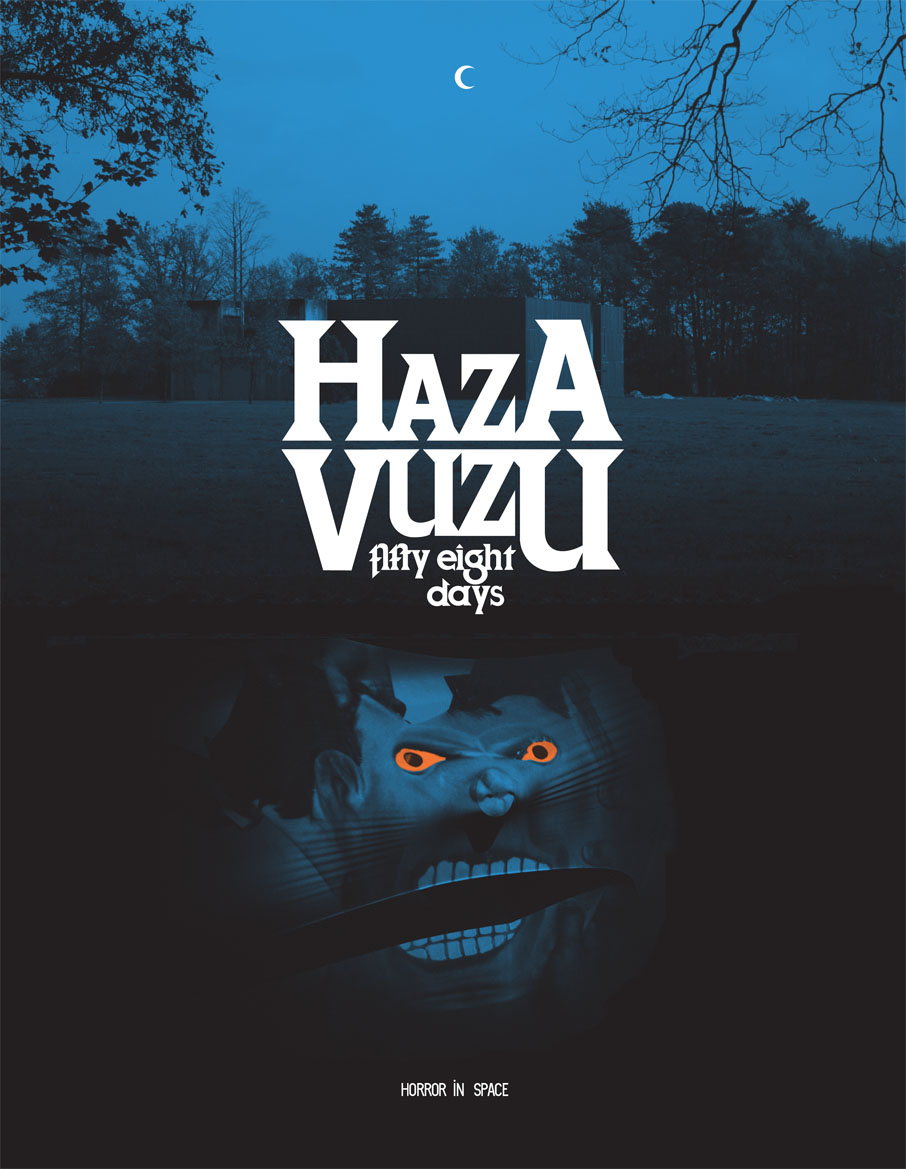
Vasıf Kortun and Céline Condorelli converse through a few things they know -and don’t- about Ha Za Vu Zu.
This book documents a form of cabin fever experienced by Istanbul based collective Ha Za Vu Zu during their fifty eight days residency at the Frac des Pays de la Loire, Nantes. Ha Za Vu Zu were invited to participate in the “23e Ateliers Internationaux du Frac des Pavs de la Loire” by Vasıf Kortun.
Céline Condorelli: It was through you that I got to know Ha Za Vu Zu. The first time I saw them play was at the end of an Open Studio day at Platform in 2008, while I was in residency there; everyone went up to the fifth floor; something was going on up there; people were playing, others were sitting all over the room, and different seemingly unrelated things were happening, it was confusing and fun, and it just went on and on and on… I didn’t exactly understand what was going on, but there was music, noise, talking, and the whole thing was extremely funny.
Vasif Kortun: I remember that night; it looked like none of them knew how to play; all the meanwhile, they were, without a doubt, playing together. They had certainly rehearsed and played with each other before, but it wasn’t like they were in unison, and yet they were creating some continuous rhythmic fellowship thing… I enjoyed that, did you?
CC: I enjoyed the evening very much, I had expected it to be a small concert, but it was more of a landscape than a sequence of songs somehow.
VK: Yes, that is precisely it. It was like a… plateau.
CC: There was all this simultaneous activity, some singing, declamations, and people getting up; once in a while, someone would be shouting, or miming, or giggling… The experience of seeing them perform, which I did three times, was of almost total puzzlement mixed in with contagious enthusiasm. Do you think it was a performance or more of a concert? I guess this is a question between the work they do as artists and what they do as musicians.
VK: Ha Za Vu Zu are semi-good in everything, but only semi, which is great. I would not want to break the work apart and segment it as a concert or a performance, as there is real enjoyment in its complexity; I think there is an overall general concept that predetermines everything they do, but it is like an open system, in which different things can be plugged in or out.
CC: And I couldn’t understand what they said! Not speaking Turkish, I couldn’t make the difference between sounds that were just that, and those that were words too, and carried other meaning across. I thought other people could make sense of it all, and it took me a while to understand that in fact nobody understood anything. I was wondering about this ambiguity in reference to the Turkish language switching from an Arabic-based Ottoman alphabet to a modified Roman one, as it was orchestrated by Kemal Atatürk in 1928. This process of language re-invention seems to happen with Ha Za Vu Zu’s work, but the other way around, from noise through sound to language and back again.
VK: Their work isn’t pre-lingual, but it makes sense. And it is also very amusing. It recalls the historical avant-garde, the early twentieth-century collapse of language into utterances and nonsensical break-ups, which can be understood as the breakdown of the rational. Their work references that period, from dada experiments on, in the way in which it disregards anything that has to do with the cogito. It is not coherent, and yet it comes out as a very intelligent strategy because the incoherence is manipulated. It doesn’t come out naturally, it is not an expression of style. They invent it, and they play along with it.
CC: Yes they seem to work against meaning, against simplified notions of a higher sense behind things and actions. And as their performances are very rehearsed, the noise is not unaffected or primal in any way. Can you explain a little more about how you think it relates to this history?
VK: A huge scientific moment precedes the First World War: an age of amazing invention, from submarines to airplanes, technological and conceptual breakthroughs. That time seems to be permeated with a belief that everything is going to be amazing, because the future is scientific, it beholds all promises and one should rush towards it. Concepts of speed flourish, from the Italian futurists to Delaunay’s painting L’Avenir dans l’Air… The First World War shattered the promise that science seemed to be offering, and that is when language collapsed; it led to Dada and Surrealism, and so on. And I was thinking that Ha Za Vu Zu deals with language in a not dissimilar way to how those movements did. Historically, the Turkish language has been rewritten from one script to another, and sifting out “alien” words happens a bit later. Still, it does have to do with a parallel Westernizing moment. It takes place not just in the script but in a substantial change of words too: to institute the new, they introduced a whole set of nonsensical, formalist attires. This produced a massive confusion between the body and the self, language and utterance, desire and moderation. Perhaps the shift I am trying to explain does have something to do with that.
CC: What is interesting in such a revision of language is what needs to be reinvented, because there is no such thing as a complete, equivalent translation from one set of components to another. What I see as a context to Ha Za Vu Zu is not the Turkish nationalist project, but the fact that the invention of language is a political move… and within this movement, this trajectory, Ha Za Vu Zu decide to go backwards, they leave language and go towards noise, and in this way perhaps allow the articulation of a voice that cannot be inscribed in those greater narratives of history. But they make this look effortless, harmless. How did you meet them?
VK: I didn’t really meet them. One was my student, Güneş, and I saw their works around. They were sharp and fun, so we got to know each other personally, in friendship, and only afterward through working together. My experience of them comes from watching them kind of intimately. They are very different people between them, and of course, with the one girl… if you read it in a musical situation, she’d be a front girl like Debbie Harry in Blondie. But things happen between all of them, they have known each other for a very long time and are very close. What I don’t understand is the whole project’s setup: I can’t tell who has drawn what, who has sown which backdrop flag or crafted an individual CD cover…
CC: Perhaps it is important that Ha Za Vu Zu has collective voice. There is something interesting about a collective’s position, because it messes up pre-conceived ideas of authorship, and allows each member to exceeds his or her own voice… I actually like this dimension of their work a lot: as another act of scrambling, it unsettles everybody’s expectations because it does not let you rely on predefined roles.
VK: They seem to talk together and discuss things extensively. There is also this sense of an extremely sensitive and unassuming approach to materials. They roll their cigarettes from unbranded tobacco, never touch anything labeled, make their own shirts and things, and madly recycle images, things, objects, cables, and equipment. Their frugality is amazing, yet you will not see them in protest marches.
CC: While the art world –in Istanbul and elsewhere- is becoming hyper-commercialized, Ha Za Vu Zu does appear to go against the grain, with their practice being hard to place, performers and musicians at the same time, without any recognizable leader or leading figure, and the slightly old school hippiness about them. They are actually, paradoxically, rather unglamourous -a relief from the surrounding artistic and musical ambitions.
It is interesting to have collective activity without somebody as a locomotive, pulling the whole thing through, and it is also really uncommon. Collectives in the art world are rare, or else they tend to be temporary, and unreliable. Unfortunately, unless you are Gilbert and George and have been in the business for thirty-odd years, collectives do not seem to appeal to museums, collectors or established institutions; these mostly deal with material objects, which makes investing in this kind of work unlikely at best. The reasons given are always questions on the stability and recognition of authorship: what if they have an argument, what if they fight and separate, what if the work becomes discontinuous? This is how collectives are always seen as a liability to the general context.
And they are often financially unsustainable in the long term—even though they often arise out of difficult contexts and the need to get together to change things. Being part of a collective makes it more expensive to travel and do things, yet you earn less money. Perhaps that is part of a resistance strategy?
VK: You have to divide everything up between yourselves! There is a form of resistance there, one that immediately weeds out the people and institutions you do not want to work with in the first place. Perhaps this is quite a good idea as a way of working. I just realised that they do have a way of dealing with the commercial context and failing at it, too. But their individual practices are present in the collective one; it is all threaded together.
CC: Somehow this is taken into the performance as well, as it does not overwhelm the public or the individual members, but one feels part of the making of something in varying degrees. In that concert on the fifth floor of the studio building, at some point the boundaries between who was performing and who was not, dissolved, in laughter -there are elements of a clown show in this. The frames were very malleable: they didn’t have a forty-five minute slot, nor a stage, they didn’t have to pack up or even bring stuff as they were already there long before it started. The evening unfolded in the room where they had been rehearsing for months. Studio-like situations create a specific atmosphere, of things in process, of live experimentation. This brings us to another process-based element of their work which might be interesting to discuss with you, which is that of residencies. Ha Za Vu Zu recently went on a residency and spent two months talking in a house in the middle of nowhere. And watching horror films. It sounded both wonderful and exhausting: so much time to do things together -as they were so isolated- so much energy spent negotiating. You probably have more experience of residencies and their failures than anyone else I know…
VK: It was a great idea to have them all together and take them out of their Istanbul rhythm of performing every other day. A residency can offer this kind of time bracket, which one wouldn’t normally have, and this is also what happened when you were all at Platform in Istanbul at the same time. We have had residencies since 2002, though, and it’s been eight long years of at least fifteen artists per year. And I still don’t know the magical recipe for residencies! Perhaps I know what fails, and that would be us, we failed: being in a building with six different artists all the time is a hard thing to do over a long period. But your time was great. Sometimes residencies are magical like that. You cannot anticipate it; it isn’t something that can be engineered, it just happens.
 vasıf kortun