Exhibition Brochure, November Paytner with additional comments by Vasıf Kortun, 2005
MG+ | Mala galerija, Ljubljana
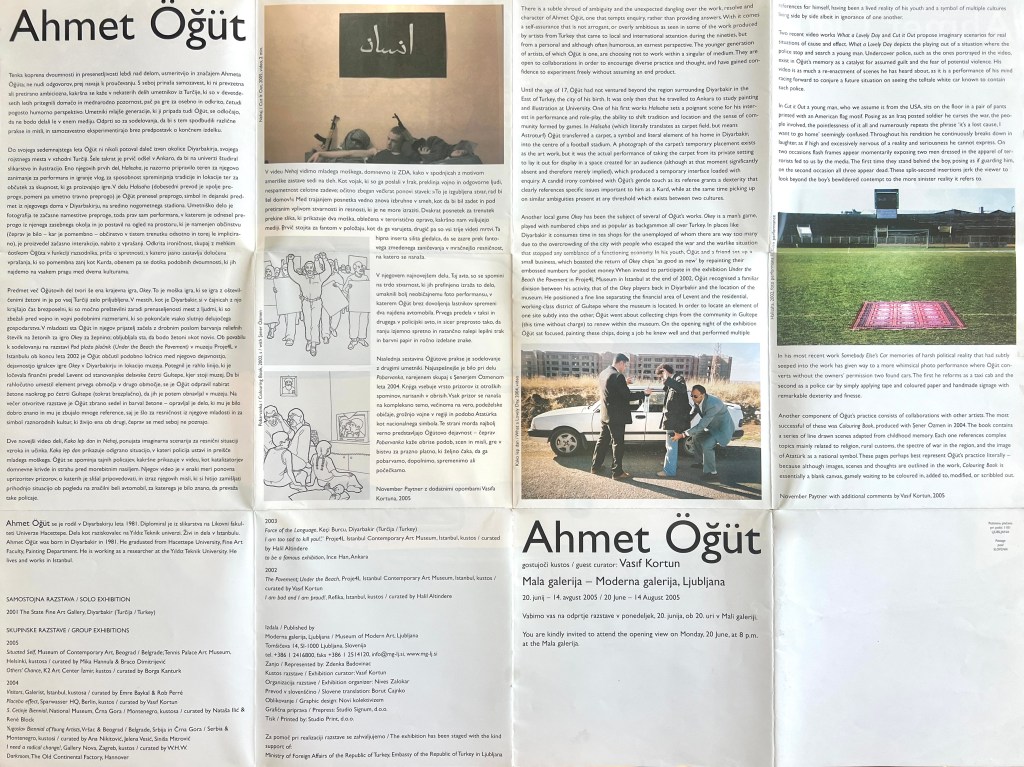
There is a subtle shroud of ambiguity and the unexpected dangling over the work, resolve, and character of Ahmet Öğüt, one that tempts inquiry rather than providing answers. With it comes a self-assurance that is not arrogant or overly ambitious, as seen in some of the work produced by artists from Turkey that came to local and international attention during the nineties, but from a personal and, although often humorous, earnest perspective. The younger generation of artists, of which Öğüt is one, choose not to work within a singular medium. They are open to collaborations to encourage diverse practice and thought and have gained confidence to experiment freely without assuming an end product.
Until 17, Öğüt had not ventured beyond the region surrounding Diyarbakir in the East of Turkey, the city of his birth. Only then did he travel to Ankara to study painting and illustration at the university. One of his first works, Halısaha, sets a poignant scene for his interest in performance and role-play, the ability to shift tradition and location, and the sense of community formed by games. In Halısaha (which translates as carpet field, but means Astroturf), Öğüt transferred a carpet, a symbol and literal element of his home in Diyarbakir, into the center of a football stadium. A photograph of the carpet’s temporary placement exists as the artwork. Still, it was the actual performance of taking the carpet from its private setting to lay it out for display in a space created for an audience (although at that moment, it was significantly absent and therefore merely implied), which produced a temporary interface loaded with inquiry. A candid irony combined with Öğüt’s gentle touch as its referee grants a dexterity that references specific issues important to him as a Kurd while at the same time picking up on similar ambiguities present at any threshold that exists between two cultures.
Another local game, Okey, has been the subject of several of Öğüt’s works. Okey is a man’s game played with numbered chips, and it is as popular as backgammon all over Turkey. In places like Diyarbakır, it consumes time in tea shops for the unemployed, of whom there are far too many due to the overcrowding of the city with people who escaped the war and the war-like situation that stopped any semblance of a functioning economy. In his youth, Öğüt and a friend set up a small business, which boasted the return of Okey chips ‘as good as new.’ He carefully drew a boundary between the Levent financial district and the Gültepe residential and working-class district, where the museum is situated. To subtly locate an element of one site into the other, Öğüt collected chips from the community in Gültepe (this time without charge) to renew within the museum. On the opening night of the exhibition, Öğüt sat focused, painting these chips, doing a job he knew well and that performed multiple performance
references for himself, having been a lived reality of his youth and a symbol of multiple cultures living side by side, albeit in ignorance of one another.
Two recent video works, What a Lovely Day and Cut it Out, propose imaginary scenarios for real situations of cause and effect. What a Lovely Day depicts the play-out of a situation where the police stop and search a young man. Undercover police, such as the ones portrayed in the video, exist in Öğüt’s memory as a catalyst for assumed guilt and the fear of potential violence. His video is as much a re-enactment of scenes he has heard about as it is a performance of his mind racing forward to conjure a future situation upon seeing the telltale white car known to contain such police.
In Cut it Out, a young man, who we assume is from the USA, sits on the floor in a pair of pants printed with an American flag motif. Posing as an Iraq-posted soldier, he curses the war, the people involved, and the pointlessness of it all and repeatedly says, “It’s a lost cause; I want to go home,” seemingly confused. Throughout his rendition, he continuously breaks down in laughter, as if high, and excessively nervous of a reality and seriousness he cannot express. On two occasions flash frames appear momentarily exposing two men dressed in the apparel of terrorists fed to us by the media. They stand behind the boy the first time, posing as if guarding him; on the second occasion, all three appear dead. These split-second insertions jerk the viewer to look beyond the boy’s bewildered contempt to the more sinister reality they refer to.
In his most recent work, Somebody Else’s Car, memories of harsh political reality have given way to a more whimsical photo performance where Öğüt, without the owners’ permission, converts two found cars. The first he reforms as a taxi cab and the second as a police car by simply applying tape and colored paper and handmade signage with remarkable dexterity and finesse.
Another component of Öğüt’s practice consists of collaborations with other artists. The most successful of these was Colouring Book, produced with Şener Özmen in 2004. The book contains a series of line-drawn scenes adapted from childhood memory. Each one references complex topics mainly related to religion, rural customs, the specter of war in the region, and the image of Atatürk as a national symbol. These pages perhaps best represent Öğüt’s practice literally—because although images, scenes, and thoughts are outlined in the work, the coloring book is essentially a blank canvas, gamely waiting to be colored in, added to, modified, or scribbled out.

