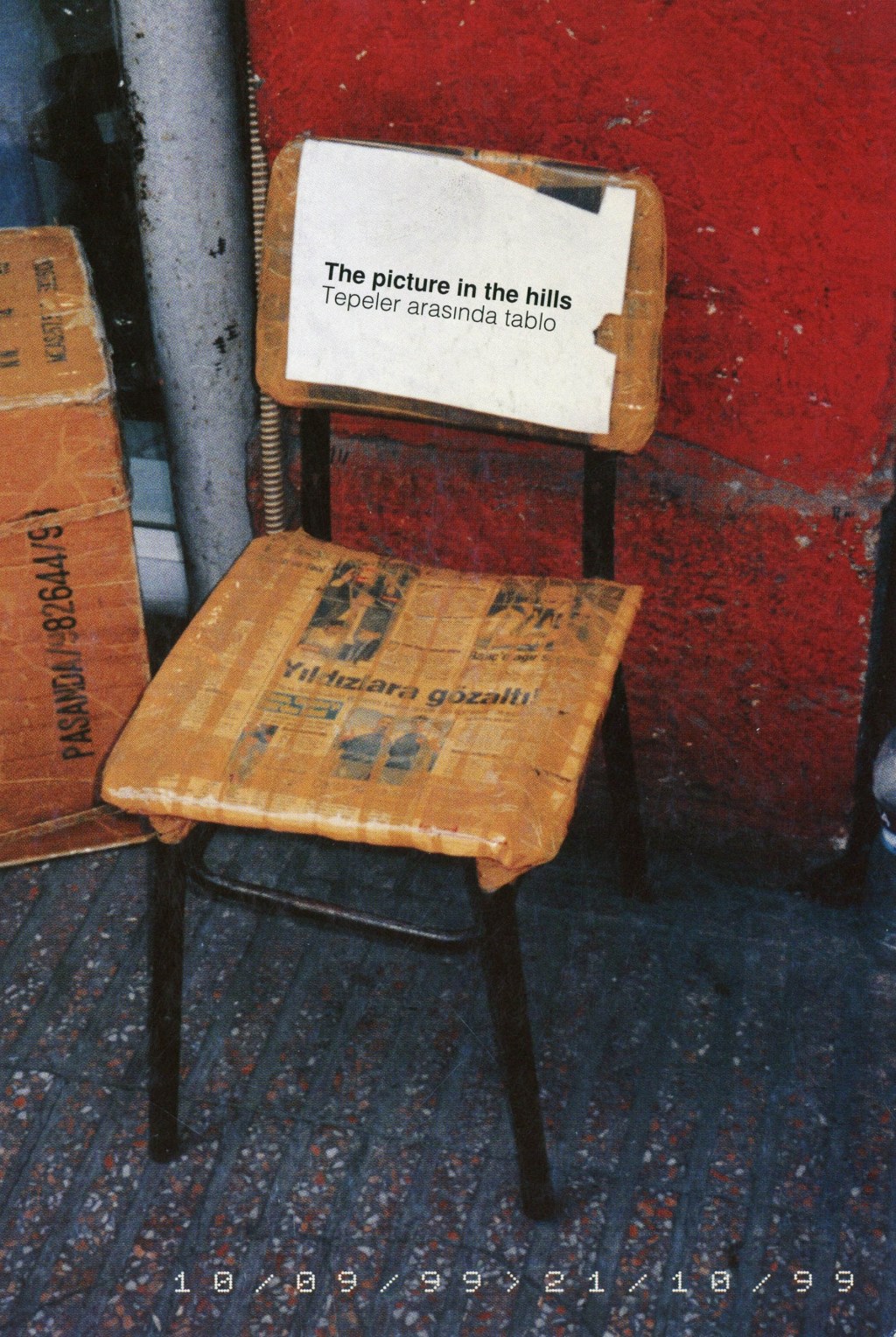
Dulcinea, Istanbul, 1999
Vasif Kortun: I would like to start by addressing the issue of Courbet’s reappropriation. In the exhibition we see a reproduction of a Courbet painting confronting us in monumental ways. This is definitely because it is a piece whose location was unknown. In a sense it signifies the pornographic “image d’épinale” that was the rage among Parisian men of the 19th century. The Ottoman ambassador to Paris, Halil Bey, who had an interest in this field of “image d’épinale” commissioned the painting, and he presented the work in his house with its surface covered over. This field of special interest sought to totally overturn the literary classical nude representation as exemplified in Manet’s “Olympia” and through formulating the issue vis-a-vis the public perception of a prostitute. Here one is confronted with the moral dilemma of the breakdown of the boundaries of publicly accepted perceptions and viewing in the private sphere. In monumentalizing this piece, you scramble up two issues at once: the first being moral stance and a problematic of vulgar feminism; the second being the other meaning inherent in the painting, a pushing to the fore the issue of “source.”
Hüseyin Alptekin: While I was wandering around Berlin with a copy of Bernard Teyssedre’s “Le roman de l’Origine” (“The Novel of the Origin,” 1997), I saw a notice in a cinema magazine that read “in vagina veritas.” The Latin term “in… veritas” is used to denote things of the most sublime; for instance, one would raise a glass of wine saying, “in vino veritas” (meaning “in wine lies truth,” “truth is in wine”). Bernard Teyssedre’s “Le roman de l’Origine,” which came out in the L’infini series of Gallimard publishing house, is a book totally based on Courbet’s L’Orgine du monde “In vagina veritas,” and the red cloth draped on the cover of the book, when brought together, formed a collage that stuck in my mind for over two years. The known story of this painting, along with the hidden, finalized, and unknown aspects of art history, and with my ongoing work concerning the problematic of appropriation and reappropriation, through this coincidental collage, opened up for me a new avenue of endeavor. Via this choice and decision, the issues that interest me concerning source, origin, attribution, and plagiarism once again became my agenda. While painting this commissioned piece, Courbet only objectified a particular section of the model, objectifying the stripping down of the model to its barest state, to a completely different, unforeseen level. By totally withdrawing from the model, an icon-—an object is produced wherein he has appropriated the painting. This painting is an object where the individuality and personality of the subject-—that being a woman-—have been removed; it is the exhibition of an undefined organ. It is a woman without a head, legs, and arms, a female organ. This painting is reminiscent of a landscape that presents one with a view of extreme freedom and is, in any case, a presentation of the amoral.
Vasif Kortun : Courbet’s figures evoke social class and exude a sense of realism. The female prostitutes on the banks of the Seine or the sleeping women (“Sleep,” 1866) are presented from the male perspective and seem to denote a lesbian relationship. This painting was in Halil Bis within a far more moral context. I don’t know if over time these questions concerning the representation of women in terms of these principles became less problematic. Yet, they were conceived according to obvious codes and a discipline, and I believe that paintings depicting women carelessly clad were in fact far removed from the pornographic and exploitative level. Getting away from the issue of nudity or scantily clad figures, I would like to pose this question: Is there another structure over which this perspective of reappropriation is based?
Hüseyin Alptekin: During this period I was working on the relationships between the veiling of thought forms among various cultures in terms of the use of form and conception as exemplified in Slavoj Zizek’s Fantasies (“The Plague of Fantasies”). Zizek analyzes the myths and psychoanalytic states of various societies in Lacan. He discusses the closet conceptions and different toilet mores of German, French, and Anglo-Saxon cultures and discusses the veiling of the political and philosophical thought forms within those cultures. The connections between food and toilet mores as established by the anthropologist Claude Levi-Strauss are pointed out: eating customs related to the raw, the cooked, and the boiled; these trinitarian typologies are used as an analogy in pointing out the customs regarding the shaving of pubic hair for women. One can contrast the hippy sensibility of the raw, unshaven, messy pubis with the cooked modern, new wave bikini line pubis shaving style; the boiled would be represented by the completely shaven punk sensibility. This known painting of Courbet’s is an intriguing example exemplifying this first unruly, messy, primeval typology. The source of the world is something whose content is unknown and within which lies a lost forest; it is an untouched order, a meditative thing. I took this as I found it—the collage, the stories, the problem concerning appropriation, Zizek’s Lacan studies – by coincidence in combining the fact that the painting in question turned up in Lacan’s collection in 1955; I shaved the pubis in the painting with the statement “in vagina veritas.” This sentence is an answer to “L’Origine du monde.” That is, it is in the context of the actual source. The form of different expressions is brought about by different lifestyles. This has to do with social and cultural facts; in shaving and scraping away at the essence—at the source hidden within the original— the idea to find something was born. While shaving an atomic structure with a genuine textural transfer (with a digital shave) within the cultural typology of the painting, a secondary reappropriation version, one appropriate to the boiled/punk style, emerged. This time, the truth, the original, is sought for in the label “in vagina veritas” tattooed, where the memory in zero degree is reduced to a tabula rasa.
Vasif Kortun: Let’s get to your position on appropriation in borrowing a painting from Courbet…
Hüseyin Alptekin: In the discussion concerning the reappropriation of something pertaining to art, in art history, in appropriating something that in and of itself has its own integral place, if within this established discussion one doesn’t mark one’s own departure, one doesn’t make one’s own determination, then that is plagiarism, thus the original in question and the problem of reference are removed. If one doesn’t pursue the problematic in question, if the discussion and problematic do not enshroud the borrowed work or the surface of the veiling, if this is left vacant, the send-off and relevance are left hanging in the air. The choice and wherefore of the work are critical in the process of appropriation. We see within this process the nature of philosophical knowledge and art draw very near to each other. In blowing up this painting, a few reservations were felt in terms of its being viewed as pornographic, however it was commissioned by a Muslim, an Ottoman diplomat to Paris, Halil Bey. However much he sought to evade the puritan art world of Paris at that time, I too encountered reactions from circles totally unexpected, and in a most weird manner. Yet after 133 years, it resides in a totally different ontos in another dimension within another context.
Vasif Kortun: Perhaps because I am familiar with the formulation of your work and the inside story, in terms of your cognitive adventure, it is that much more surprising for me. For example, I was there at the Sao Paulo Biennial featuring “Capacity” and the gift of an architectural student from Sao Paulo, the poem Cidade. Yet I never suspected that you would reuse this in a different ontos and that you would re-referentiate it. Let’s discuss the exhibition’s other axes.
Hüseyin Alptekin: The two versions of “In Vagina Veritas” are installed behind green and blue tulle prints. The graphic setup of the exhibition features two primary colors-the first being Prozac green, the second Viagra blue. Halil Bey used to cover the Courbet painting behind a green curtain. This mise-en-scène was established behind ultramesh green and blue tulle (today’s technology: vinyl). From the outside to within, the source, the source with its hidden truth, is this time divided between visual and conceptual routes, Prozac green and viagra blue-it is between the two that we are tending. Once again the poem “Cidade” (“Viva Vaia,” Augusto de Campos, 1958) is written with a thread of neon in prozac green over a viagra blue background. The green shining through the lightness of blue with its one word that leaves the effect of maybe being read or not, that is of two mental states-depression and delight-a lampoon that has as much to do with this as with miscomprehensions of conceptual art. In another corner of the exhibition sits a diagnosis divan covered with a white cloth on which rest three white hoops covered with white cloth, which once again, with the same light sources expound the three mottos of the exhibition. The white light “boredom,” the green “loser,” and the blue “border.”
Vasif Kortun : Here your work and exhibitions partake of a continuous reference to each other.
Hüseyin Alptekin: This is “Capacity”s and its continuation “Living Room” exhibition’s extension “Boredom.” Being made with a light emitting cable on white surface, is boredom’s lightness and is related to “Boredom” denoting a mode of space. “Loser” is prozac green and “Border” (its “order” being hidden within) is viagra blue. “Border” and “Loser” are in contrast to each other. There is a lettriste sensibility within the exhibition, that is boredom, border, loser: oeo, oe, oe; viva vaia, viagra, vagina: ia aia, iaa, aia- related to different spectrums of sound resonance. As referent to the title of the show “crisis” and the nature of being a passage and a process-work, its periodicity rests on the photographic prints specifically produced for the installation and subjective issues within an association have entered the show with a visual relationship. This work-in-progress is the characteristic of the exhibition. For instance, a book that is being read, a trip to Bulgaria, a life boat encountered on Gökçeada.
Vasif Kortun : Is this a Bulgarian cigarette print? It reminds me of the Bafra brand.
Hüseyin Alptekin: Yes, they are Varna cigarettes from an off-season trip to Varna. The piece’s name is “Out of Season”. This work has to do with the humour concerning the installation. We can see some very pop-ish stuff alongside photographic and most painstakingly dealt with processes. There’s a personal critique for the trendy execution of the digital prints and materials, with the utilization of “non-standard” sizes, as if I have gone out of proportion, using different tones and techniques to come up with an indifferent aesthetic. Amongst the lived-stories there is not a definite order relating to a non-referential reference. The installation carries a specific intention for staying away from the decorative, designed and ornamented nature of the gallery shows. For example I take a totally out of context, turn of the century photo of the Port of Hamburg and paint the life savers of a life boat with the colors of prozac green and viagra blue. Life saver is also in the photograph of Humphrey Bogart on the beach. The Varna cigarette pack features the pop-beach scene and the life boat belonging to a ship in the Port of Constanz. The thing about the process is the clicks that occur between my vision and intuition.
Vasif Kortun : Certain things, things read, issues that have been lived through are carried through time then later through a click you insure the establishment of their own universes. This is a structure that has been re-established since your “Heterotopia” exhibition. Here in the most obvious formation are the photographs on the long wall.
Hüseyin Alptekin: Here it is an issue of things from disparate ontos, spheres of being coming together to rest side by side. What affected me about the structure of the exhibition is the matter that concerns me in regards to the emblematic figure. I have been absorbed for a long time with those plastic bags that carry consumer goods, those most basic, general items that are not reflective of any social class. The bag I have taken in hand at the end sequence of the exhibition bears the label “elit.” At the head of the wall whereon the photographs are placed we see “Elite”. Elite comes from the neon sign of a Helsinki restaurant. The image centered on this neon label is a borrowing. It concerns Finnish filmmaker Karusmäki Brothers’ Moscow bar. This is a redemptive piece of work wherein the photographic portrait of the Karusmäki’s cult actor Matti Pellopää (who died two years ago of cirrhosis of the liver) is retaken, later I have visited Matti Pellopää’s favorite restaurant Elite and sat at the table he used to have dinner and decided to make this piece in memoriam. Two elites, one borrowed from Helsinki, the other found in Istanbul wherein their topographies are close yet the subjects utterly different, they however reflect certain coincidental similarities in terms of connections, context and culture. The photograph of Humphrey Bogart in swimming trunks and flip-flops is like that too. While reading a book about the love between Lauren Bacall and Humphrey Bogart I came across that photo. It is a photograph wherein those flip-flops don’t seem congruent with that hard character that we know bedecked in a smoking jacket and being oh so cool. Here it is a matter of disconnection. Bogart’s flip flops are painted with one of the exhibitions two main colors, that being viagra blue. Next to a Bogart’s photograph of a notice concerning seating capacity of a life boat that a saw on Gökçeada that is an attribution to my earlier works: capacity/capacities. The Varna cigarette packet with its label in Cyrillic seems to play a word game denoting Bafra cigarettes or Bafa lake and symbolizes a different visual sense of humor. As for the photograph of the musician Bucth Morris, it is related to our discussions on the matter of inside architecture an conducting. The picture’s name is “Contemplation”. This is a lived moment, a matter of re-establishing something lived, it has been borrowed from life, a mis-en-scène appropriated from life. One who loves to smoke cigars, while a cigar awaits him resting in the ashtray, contemplates that beloved cigar while smoking a cigarette. Here, it is as much about the fantasy of postponing pleasure as it is about fantasizing about pleasure. The piece bearing the notice lovelace was made from gobilen stitching over embroidered canvas and was imagined for the 24th Săo Paulo Biennial. Left aside to await its fruition, it is a trace that runs from this exhibition to those in the future. Lace, which denotes a completion of love, which is remembered along with love purveys meaning both in the sense of being a sucker as well as in terms of embroidery. Besides this, lovelace is once again a borrowing from disparate references and is a send off to different contexts. Like the famous porno star Linda Lovelace, it is also a borrowing of the renowned mathematician Ada Byron Lovelace whose name was given to an infobiogen server. Tulle, curtaining, veiling, removing, stitching… Fantasy deals with postponing the jouissance, inasmuch as the truth is embroidered in the dance of seven veils.
 vasıf kortun