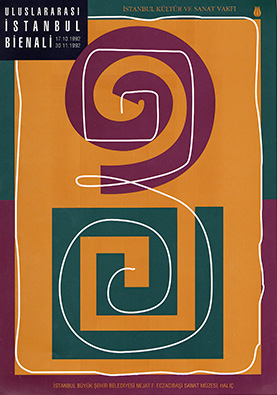
Catalog Text, Third International Istanbul Biennial, 1992
Megalopolis, which in Greek means “the great city,” reveres the town as a spiritual structure over and above its physical expansion. In the texts, the megalopolis is “transcendent” and is used to describe Athens and Troy. It is not considered a “big city” but an “insurmountable, transcendent town.”
The concept of megalopolis has little to do with the “megapolitan” administrative model that has recently been the topic of discussion for Istanbul. The megapolitan model is instead a sanctioned concept related to controlling space and administrating the populous. Conceived by default with gargantuan physical dimensions, megapolis is a misnomer and does not offer a corresponding meaning in Greek. Therefore, if the megapolis is an administrative term, megalopolis is a spiritual assessment.
Megalopolis is neither a progressive successor of the metropolis nor is it set against the background of one. Although a megalopolis may have a history, it does not have to do with the specific history of the place, nor is it dominated by an evolutionary will to gradually megalopolize. The megalopolis’s emergence may be found in a leap or in an ursprung. This seems to be the methodology for Istanbul’s megalopolizing.
Through the narration of Istanbul’s history, one tries to reconcile this ursprung, but the traditional accounting procedures do not work for this megalopolis. Now, Istanbul has broken away from a self-contained, productive city model held for most of the 20th century to make a whirling detour to the city of the late 19th century.
While the city is shocked by the waves of invasion of immigrants forced to settle – economics of necessity, its fabric, too, is seriously affected by the direct reflection of the values and customs imposed by the newcomers. Lucid and well-lighted spaces, straight and wide roads- healthy and fascistic, grand designs of circulation stamped on the city by official discourses, however, seem to fail to sustain themselves. The anti-civic will dismantle them instantly. Megalopolis represents a rupture from the preceding city models. It bears medicalizing aspects, as has been remarked by Umberto Eco and seen in Orhan Pamuk’s Black Book in the clanization of the city and the production of odd, divergent, and autonomous figures.
Megalopolis knows no physical boundaries; it articulates its periphery and is connected to its others with immaterial cables. It spirals into its history through and between other city models. It is “megalo” because it knows of no borders; it is “manic” because it is beyond reason, and while having reason, it abruptly switches to no reason in its unconscious operation.
Megalopolis does not have a center. It merely has areas with varying noise intensities. Its center is the periphery, and its periphery is the center. As the periphery converges on the center, the center produces nostalgic spaces in new pastoral settings. Thus the daily transfer and city nomadism have erratic dimensions. Some have associated the megalopolis with the metropolis and prefer using the metapolis as an alternative. For them, the metapolis is a town that thinks and speaks of itself. The metapolis regards its immediate history and its time as a déjà-vu. But Istanbul, which both experiences the déjà-vu and the jamais-vu, is different.
The cultures there are represented not only in the space of consumption but also in the Theodosian sector. The rest of the city does not open itself to circulation in souvenir shops and authentic cuisines. The town is not a vitrine. Cultures do not open themselves to tourism and touristic cognition for banal simulation. Through layers of masks, they operate on different grounds of barter and exchange. These are the areas of crime. Criminal because they are outside the organized economy. Criminal because the object of circulation is a fake, a surrogate, a simulation, a semantically warped version of an illegal kind with a parallel condition to a controlled economy. It is “organized” crime.
Being a megalopolis is Istanbul’s arrested destiny. It is between the north and the south and severs Asia from Europe as a “non-space.” The city does not have a direction of its own. Here, the geographical terminology is unburdened by the ideologies of cartographical thinking. It is not the center, for it does not revere a center; it is just there, in the middle. To claim that Istanbul is in-the-middle does not imply the satellitization of the country. Because no one is an Istanbulite, and everyone is. Istanbulite is no more a durable figure. “She” can no longer control or diffuse the space and the time which “he” once thought was “its” own.
Several conditions of existence cohabitate. The first is the will to ad hoc. Ad hoc will produce an anti-civil, despotic, dark, piecemeal existence. The other will, will strive to strip the town from ad hoc. They open grand boulevards, put up mighty buildings, and place strategic monuments. Power not only suggests the circulation of society but also dictates the social architecture of the individual body.
The photographs of young couples in front of the city’s waterworks in Taksim Square evoke the nostalgic days of a small population. These are merely a yearning for a youth in photographs for which the originals do not exist. The nostalgia of modern times is only felt by the few whose main task was to anticipate a linear trajectory of progress. It is their crisis. Their passage from the renovationist modernism to a new paradigm has proved to be more painful than ever thought. The “others,” meanwhile, are postmodern by definition and in actuality. They quickly transport the phantasmagoric succession of identities from a pre-modern to a postmodern condition with ease and consistency. Renovationist modernists, however, with their short-term memory of the republic (a memory which, if anything, constitutes an erasure), remain a colorless elite.
As in a few other cities, ad hoc is the sole law of Istanbul. The reuse, semantic shifting, articulation, montage, and collage determine the operation conditions here. Ad hoc, which in every way penetrated each area of the society- as seen in the half-finished yet habited buildings awaiting vertical expansion (a sign of vertical nomadism itself), sets the course of daily life. As proposed by Charles Jenks and Nathan Silver in Adhocism, use depends on found objects or conditions as economic feasibility only from the point of temporary value. The principle of montage is also significant. Although it can also be used for a particular phase of Turkey’s economy – a period which also coincides with massive migration to the cities – it goes further in the sense that montage does not seek to produce a heretofore unseen object. Still, it is inclined to define a new ontology through the reuse and the odd articulation of disparate objects.
If kitsch and ad hoc resonate with each other, not based on objects but on attitude and stance, certain conditions could easily be called kitsch. The ad hoc montage is also a phenomenon of the kitsch condition and can not be discussed on the object’s status or relegated to “low-culture.” There is, of course, a difference in use in art and life. There is also quite a difference between being ad hoc, not knowing that one is ad hoc, and being completely aware of an ad hoc operation. The latter condition applies to the artists of Turkey in this Biennial.
 vasıf kortun